
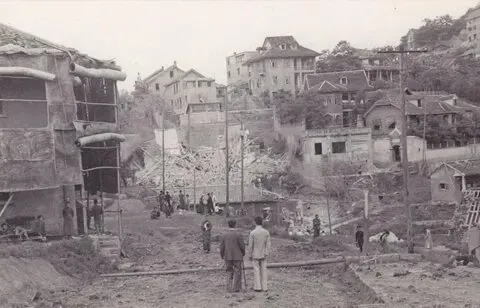
Bomb shelters, ration lines, and resilience defined the city that stood against Japan’s advance.
A Capital in Exile
When Japanese forces captured much of eastern China in the late 1930s, the Nationalist government under Chiang Kai-shek relocated its capital from Nanjing to Chongqing, a rugged city perched on the upper Yangtze River. Between 1938 and 1946, this mountainous stronghold became the wartime capital of China, symbolizing both survival and sacrifice.
Chongqing’s geography made it defensible but difficult. Surrounded by cliffs and rivers, the city was hard for ground forces to seize but highly vulnerable to aerial bombardment. For eight years, its residents endured relentless air raids, food shortages, and cramped living conditions, forging a collective memory of hardship and resilience.
The Bombing of Chongqing
From 1939 to 1943, Japanese warplanes launched one of the longest aerial bombing campaigns of World War II against Chongqing. Hundreds of raids killed tens of thousands of civilians and destroyed large parts of the city. Residents took shelter in caves and tunnels dug into the hillsides, often waiting for hours in suffocating darkness.
Despite the devastation, the city never surrendered. Bomb shelters became symbols of endurance, while newspaper offices and radio stations continued broadcasting messages of defiance. For many Chinese, Chongqing represented the beating heart of resistance against Japanese aggression.
Life Under Siege
Everyday life in wartime Chongqing was marked by scarcity. Food was rationed, and inflation soared as supply lines were disrupted. Families often stretched meager resources, relying on communal kitchens or aid shipments.
Yet cultural life persisted. Theaters staged patriotic plays, writers like Lao She and Ba Jin published works reflecting the times, and artists captured the resilience of ordinary citizens. Education also continued, with universities relocating from coastal cities to makeshift campuses in Chongqing’s hills.
The combination of hardship and cultural vitality gave the city a unique wartime identity: a place where survival and creativity coexisted.
International Presence
Chongqing was not only China’s capital but also a hub of global diplomacy. Foreign embassies, including those of the United States, the Soviet Union, and Britain, operated from the city. Supplies from the Allies arrived via the perilous Burma Road, later replaced by the Hump airlift over the Himalayas.
American envoys, including General Joseph Stilwell, coordinated aid and military training. Soviet advisors also played key roles in supporting China’s resistance. The presence of foreigners added an international dimension to Chongqing’s wartime atmosphere, turning the city into a global frontline against fascism.
Social Tension
Behind the patriotic narrative, life in Chongqing was also marked by inequality and strain. Wealthier residents often secured better food and shelter, while the poor suffered disproportionately from bombings and shortages. Corruption plagued relief efforts, breeding resentment among ordinary citizens.
Political tensions simmered as well. While the Nationalist government portrayed Chongqing as a bastion of unity, relations with the Communists remained fraught. The uneasy alliance against Japan masked deeper divisions that would soon erupt into civil war after 1945.
Memory and Legacy
When the war ended in 1945, the Nationalist government returned to Nanjing, and Chongqing’s role as capital came to a close. Yet the memory of those years endured. Survivors recalled the city as a place of both suffering and pride, a symbol of China’s determination to resist foreign invasion at any cost.
Today, museums in Chongqing preserve artifacts from the bombings and the wartime government. Oral histories capture the voices of those who endured air raids, rationing, and displacement. For many Chinese, Chongqing embodies the spirit of national resilience during one of the darkest periods of modern history.
Conclusion: The Mountain City That Endured
Chongqing’s wartime story is not just about military strategy or political leadership. It is about ordinary people who faced daily terror yet continued to work, learn, create, and hope. The city stood as a reminder that even in the face of overwhelming odds, resilience can turn a place of hardship into a symbol of national pride.
Revisiting Chongqing offers insight into how endurance shaped China’s wartime identity and how the memory of those years continues to resonate in the nation’s collective consciousness.

