
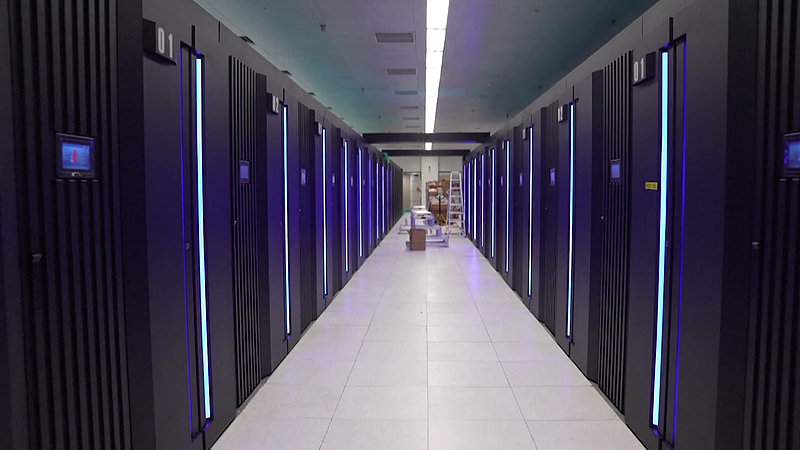
A New Milestone in China’s Supercomputing Ambitions
China has taken another significant step in advanced research infrastructure with the launch of a scientific computing intelligent agent within its national supercomputing network. Unveiled in Tianjin, the system represents a shift in how researchers interact with high performance computing resources. Instead of manually managing complex workflows, scientists can now rely on an intelligent agent that understands natural language instructions and autonomously handles many of the most time consuming tasks in computational research.
The launch highlights China’s broader effort to combine artificial intelligence with large scale computing to accelerate innovation across scientific and industrial fields.
What the Intelligent Agent Can Do
According to reports from China Science Daily, the new agent is designed to manage the full lifecycle of scientific computing tasks. It can break down research objectives, allocate computing resources, call relevant simulation software, analyze output data, and generate structured reports.
Tasks that previously required an entire day of coordinated effort can now be completed in roughly one hour. The system already supports close to one hundred high frequency scientific computing scenarios, making it immediately useful for a wide range of research applications.
Lowering Barriers to Advanced Computing
One of the most significant aspects of the new agent is its ability to reduce the technical barrier to supercomputing. Traditionally, access to high performance computing required specialized knowledge of programming, scheduling systems, and domain specific tools.
By integrating with a broader artificial intelligence community and repository, the agent can assemble more than one hundred twenty domain specific knowledge bases. These span seven major scenarios, including artificial intelligence, scientific intelligence, industrial simulation, and materials science. As a result, researchers can focus more on scientific questions rather than technical configuration.
Integrating Fragmented Resources
Modern scientific research often depends on fragmented resources, scattered across different computing centers, software environments, and data repositories. The intelligent agent addresses this challenge by integrating compute power, toolchains, and knowledge resources into a unified interface.
This integration allows the national supercomputing network to function more like a coordinated system rather than a collection of isolated machines. Researchers benefit from smoother workflows and faster turnaround times, especially for complex, multi stage simulations.
From Computational Science to Intelligent Science
Qian Depei, an academician of the Chinese Academy of Sciences, described the development as a sign of a broader transition in scientific research. He noted that science is moving from traditional computational models toward intelligent science, where systems actively assist in problem solving rather than simply executing instructions.
In this context, scientific computing agents represent a new layer of capability. They do not replace researchers but amplify their productivity by handling routine complexity and enabling faster experimentation.
Implications for Research Productivity
The productivity gains promised by the intelligent agent could have far reaching effects. Faster simulations and easier access to computing resources allow researchers to test more hypotheses in less time. This accelerates discovery cycles in fields such as materials development, climate modeling, and industrial design.
For early career researchers and smaller research teams, the system may be especially impactful. By lowering entry barriers, it democratizes access to tools that were previously limited to highly specialized groups.
Strengthening China’s Innovation Infrastructure
The launch of the agent fits into China’s long term strategy of strengthening foundational research capabilities. Supercomputing is viewed as a strategic asset, supporting everything from basic science to advanced manufacturing and national security.
By embedding artificial intelligence directly into the supercomputing workflow, China is aiming to extract greater value from its existing infrastructure. This approach emphasizes efficiency and usability rather than raw computing power alone.
A Platform With Global Relevance
While the system was developed for China’s national network, its underlying concept reflects a global trend. Research institutions worldwide are exploring how AI can simplify scientific workflows and make advanced computing more accessible.
China’s implementation demonstrates what is possible at scale. If successful, it may influence how other countries design future research platforms and manage shared computing resources.
Looking Ahead for Intelligent Computing
The debut of the scientific computing agent marks an early stage in what is likely to be an evolving ecosystem. As more scenarios are added and knowledge bases expand, the system’s capabilities will grow.
For China’s research community, the agent represents a practical step toward faster, more inclusive innovation. By turning supercomputing into a more intuitive tool, it helps bridge the gap between ambitious scientific ideas and the computational power needed to realize them.

