
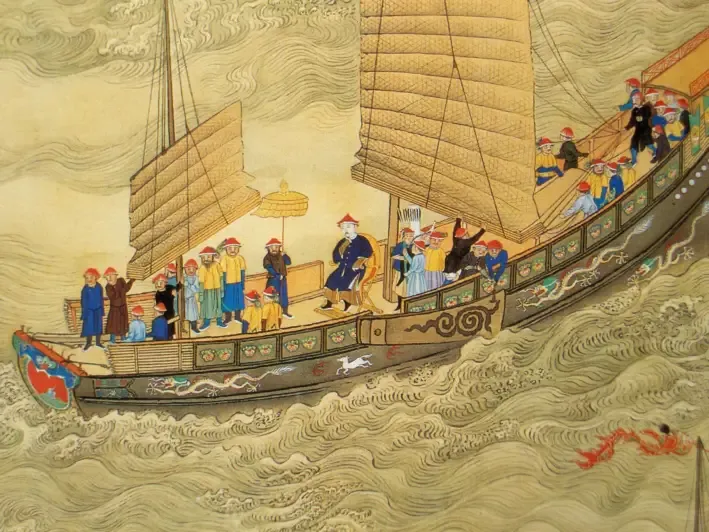
In the early fifteenth century China launched one of the most ambitious maritime enterprises in world history. Under the command of Admiral Zheng He, the Ming dynasty dispatched massive fleets that sailed across the South China Sea, the Indian Ocean and as far as the east coast of Africa. These voyages were unprecedented in scale, featuring enormous treasure ships, sophisticated navigation systems and crews numbering in the tens of thousands. At a time when few nations dared to venture far from their shores, China projected a confident maritime presence that surprised and impressed the world.
A mission of diplomacy, trade and prestige
Contrary to later myths, the Ming voyages were not imperial conquests. Their primary purpose was diplomatic engagement. Zheng He’s fleet carried silk, porcelain and other gifts to foreign courts, inviting rulers to participate in a tributary system that emphasized peaceful exchange.
Through these exchanges China strengthened its ties with kingdoms in Southeast Asia, India, the Persian Gulf and East Africa. Envoys returned with exotic animals, precious goods and knowledge that enriched the Ming court. The voyages showcased China’s extraordinary shipbuilding ability and affirmed its status as a global power capable of peaceful outreach.
Innovation at sea and mastery of navigation
The success of the voyages reflected centuries of Chinese innovation. Ming shipbuilders constructed treasure ships far larger than anything seen in Europe at the time, sometimes reaching lengths of more than one hundred meters. These vessels supported long distance ocean travel with multiple decks, advanced rudders and compartmentalized hulls that improved safety.
Chinese navigators used magnetic compasses, star charts and detailed maritime logs to guide their routes. Their skills allowed the fleet to travel thousands of kilometers with precision. This mastery of oceangoing technology marked a high point in China’s maritime development.
Why the voyages eventually stopped
Despite their success, the voyages ended abruptly after 1433. Shifts within the Ming court played a major role. Influential officials argued that the expeditions were too costly and unnecessary, especially as threats along China’s northern borders demanded greater attention.
Confucian scholars who viewed maritime trade with suspicion pushed for policies focused on agriculture and internal stability rather than international outreach. Over time shipbuilding projects were scaled back, naval strength declined and China’s maritime influence gradually faded. The end of the voyages signaled a significant turning point in the country’s relationship with the wider world.
A legacy that still resonates
Though the voyages lasted only a few decades, their impact continues to shape China’s historical memory. They demonstrate that China once possessed not only the capacity but the ambition to engage globally through diplomacy, exploration and cultural exchange.
Today, discussions about maritime strategy and global connectivity often reference Zheng He’s journeys as symbols of peaceful outreach. The voyages offer a reminder that China’s past engagement with the world was multifaceted, combining technological strength with cultural openness.
Why revisiting the Ming voyages matters today
Understanding the Ming voyages enriches our view of China’s maritime identity. They illustrate a period when China looked outward with confidence, curiosity and diplomatic intent. For historians and policymakers alike, this history highlights how maritime engagement has long been part of China’s global presence.
In a world shaped by trade routes, sea lanes and international cooperation, the legacy of the Ming voyages provides important context for China’s evolving role on the global stage.

