
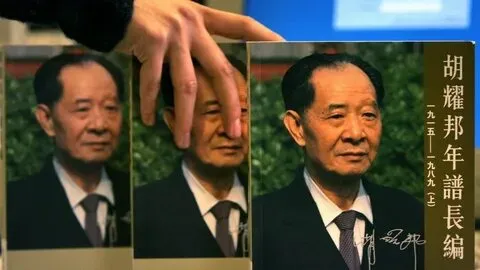
A liberal voice within the Party whose downfall reshaped China’s political trajectory.
The Rise of a Party Loyalist
Hu Yaobang’s life reflects the paradox of China’s post-revolutionary politics. Born in 1915 to a poor family in Hunan province, he joined the Communist Party as a teenager and marched in the Long March, forging ties with the revolutionary generation. His loyalty to the Party was unquestioned, yet his vision for its future set him apart.
Hu climbed the ranks after 1949, serving in various roles, but his reputation was cemented in the 1970s when he helped rehabilitate officials purged during the Cultural Revolution. At a time when suspicion and factionalism still gripped Beijing, Hu’s insistence on fairness and reconciliation signaled a new, more open political style.
Champion of Reform
When Deng Xiaoping consolidated power in the late 1970s, Hu Yaobang became one of his closest allies. As Party General Secretary in the 1980s, Hu pushed for bold reforms: loosening censorship, encouraging intellectual debate, and reducing ideological campaigns in favor of pragmatic governance.
He supported young intellectuals and students, advocating a more tolerant environment for criticism. Universities, publishing houses, and newspapers felt a brief surge of openness under his leadership. For many, Hu embodied the hope that China could modernize politically as well as economically.
The Limits of Tolerance
But Hu’s liberal instincts clashed with entrenched Party orthodoxy. When student protests erupted in 1986, calling for faster reforms and greater freedoms, Hu resisted harsh crackdowns. Instead, he urged dialogue and patience. Conservative leaders accused him of weakness, claiming his leniency encouraged unrest.
In early 1987, Hu was forced to resign under pressure, humiliated despite his long service. Deng Xiaoping, while still valuing Hu personally, calculated that maintaining Party unity required sacrificing his reformist ally.
Death and the Spark of 1989
Hu remained a respected elder until his sudden death in April 1989. His passing triggered spontaneous mourning among students in Beijing. Crowds gathered in Tiananmen Square to honor him, but the vigils quickly evolved into broader demands for democracy, transparency, and an end to corruption.
What began as grief for a reformer became the largest political movement in China since 1949. For the Party leadership, Hu’s memory became a dangerous symbol proof that reformist ideals still held mass appeal. The protests culminated in the violent crackdown of June 1989, etching Hu’s legacy into one of the most turbulent chapters of modern China.
A Divided Legacy
Hu Yaobang is remembered differently inside and outside China. To many Chinese citizens, particularly the students of the 1980s, he symbolized courage, honesty, and a willingness to listen. To Party conservatives, he represented instability and the risks of loosening control.
His rehabilitation in official narratives has been partial at best. While acknowledged as a loyal revolutionary, his role as a reformer is often downplayed in state histories. Yet his name continues to surface in moments of dissent, a reminder of an alternative political path that was cut short.
Conclusion: The Reformer Who Could Not Prevail
Hu Yaobang’s story is not one of failure but of possibility. He proved that reform and openness could coexist with Party loyalty, that leadership could be humane as well as firm. His downfall revealed the limits of tolerance in a system that valued stability above all else.
In today’s China, his legacy resonates as both inspiration and warning. For those who still hope for political reform, Hu remains a touchstone. For Party leaders wary of instability, his fate is a reminder of the costs of moving too far, too fast.

