
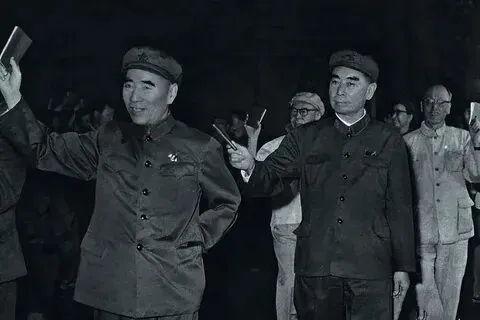
The enigmatic story of a revolutionary hero turned traitor in official history.
From Young Cadet to Red Army Hero
Lin Biao was born in 1907 in Hubei province. As a young man, he joined revolutionary forces and quickly proved himself as a skilled commander. During the Long March of the 1930s and the later battles against Japan, Lin earned Mao Zedong’s trust through discipline and tactical brilliance.
By the time of the civil war against the Nationalists, Lin was one of the Communist Party’s most reliable generals. His victories in Northeast China secured Communist control of key territories and cemented his reputation as a master strategist.
The Cultural Revolution and Rise to Power
When Mao launched the Cultural Revolution in 1966, Lin emerged as his closest ally. As Minister of Defense, he promoted Mao’s image through the Little Red Book, distributing millions of copies that turned Mao’s words into a political scripture.
Lin’s loyalty elevated him to unprecedented heights. In 1969, he was designated as Mao’s official successor, a position that placed him above other senior leaders and marked the peak of his political career.
A Personality of Contradictions
Despite his high rank, Lin was known for his reclusive lifestyle. He avoided public appearances and suffered from chronic health issues. Colleagues described him as cautious, even paranoid, preferring to work behind the scenes rather than cultivate a public image.
Yet his influence was undeniable. Lin embodied the militarization of politics during the Cultural Revolution, where the People’s Liberation Army became both enforcer and symbol of Maoist authority.
The Dramatic Fall
Lin’s downfall came suddenly and mysteriously. In September 1971, he died in a plane crash in Mongolia under circumstances that remain disputed. Official accounts claimed he had plotted a coup against Mao and attempted to flee to the Soviet Union. The narrative painted him as a traitor, erasing years of celebrated service.
Skeptics question whether Lin truly conspired against Mao or whether internal rivalries and paranoia led to his demise. The lack of transparency has fueled speculation for decades, leaving his death one of the great mysteries of modern Chinese politics.
Erased from the Record
Following his death, Lin’s name was condemned in Party documents. Textbooks removed his contributions, and his image was purged from propaganda. Once hailed as Mao’s closest comrade, he became a cautionary tale of betrayal.
This erasure highlights how political legitimacy in China is fragile, subject to shifts in Party narratives. Lin’s transformation from hero to traitor shows how history can be rewritten to serve present needs.
Reassessment and Legacy
In later years, some historians and citizens quietly reassessed Lin’s role. His military achievements remain undeniable, particularly his role in Communist victory during the civil war. Yet his political legacy remains stained by the accusations of treachery.
For many, Lin’s story reflects both the volatility of Mao-era politics and the dangers of being too close to power. His fate demonstrates how even the highest-ranking leaders could fall victim to political intrigue.
Conclusion: A Shadowed Legacy
Lin Biao’s life was one of triumph and tragedy. Celebrated as a revolutionary hero and Mao’s heir, he ended as an accused traitor erased from official history. His story illustrates the unpredictability of power in revolutionary China, where loyalty could elevate but suspicion could destroy.
Lin’s legacy is a reminder of the fragility of trust in authoritarian politics. Rising in Mao’s shadow gave him power, but it also ensured that his fall would be just as dramatic.

