
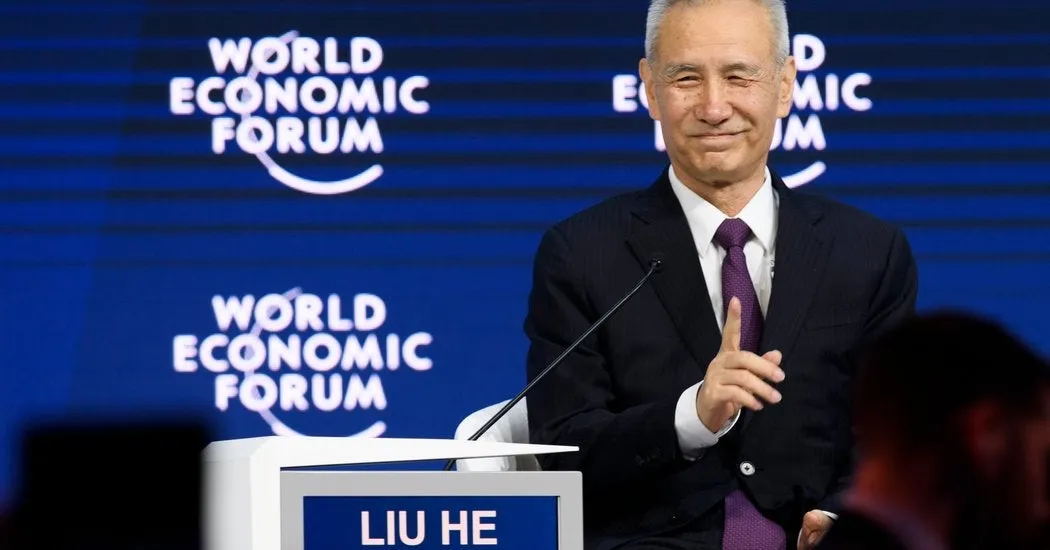
The economist who became Beijing’s voice in the global economic order.
From Scholar to Statesman
Liu He is not a household name like Mao Zedong or Xi Jinping, yet few contemporary figures have influenced China’s economic trajectory as profoundly. Born in Beijing in 1952, Liu rose from modest beginnings to become one of the most trusted technocrats in Xi Jinping’s inner circle. Educated at Harvard’s Kennedy School and trained in economics, he embodies a rare blend: globally informed yet deeply committed to China’s developmental model.
His soft-spoken demeanor masks the weight of his influence. In moments of financial turbulence and trade conflict, Liu has served as Beijing’s strategist-in-chief, the man tasked with balancing reform, growth, and geopolitical pressure.
Architect of Economic Policy
Domestically, Liu earned his reputation as the designer of financial reforms aimed at cooling China’s overheated economy. He consistently warned about systemic risks, particularly excessive debt and shadow banking. As Vice Premier, he spearheaded campaigns to reduce leverage in state-owned enterprises and curb speculative bubbles in real estate.
Though not always successful in taming China’s debt problem, Liu’s caution marked a contrast to more growth-driven officials. His emphasis on “quality over speed” aligned closely with Xi Jinping’s vision of sustainable development.
Trade Warrior in Washington
Liu stepped onto the international stage most dramatically during the U.S.-China trade war of 2018–2019. As Xi’s special envoy, he became the face of Chinese negotiations with Washington. Meeting counterparts in the Trump administration, Liu attempted to cool tensions, offering concessions on agricultural purchases while defending China’s industrial policies.
His calm, academic approach stood in sharp contrast to the bombastic rhetoric dominating headlines. For many in the West, Liu represented China’s rational core as a negotiator who understood global finance and could speak the language of Wall Street.
Yet the trade war revealed the limits of even his skill. Structural differences over technology transfer, intellectual property, and state subsidies proved intractable. While Liu managed to secure a “Phase One” deal, its fragility underscored the difficulty of reconciling China’s model with U.S. demands.
Balancing Reform and Control
Liu’s career illustrates the paradox of China’s economic governance. He advocates for market-oriented reforms, greater transparency, reduced debt, and financial liberalization, yet operates within a system increasingly defined by Party control. His loyalty to Xi Jinping has ensured his survival, but it has also constrained his reformist instincts.
Critics argue that Liu’s warnings about systemic risk often go unheeded, drowned out by the political imperative of maintaining high growth. Others suggest that his reliance on technocratic fixes cannot address deeper contradictions in China’s hybrid economic system.
The Man Behind the Numbers
Beyond policy, Liu is known for his modest lifestyle and scholarly habits. Colleagues describe him as meticulous, preferring data-driven analysis over ideological debate. His ability to bridge domestic politics with international finance has earned him respect across borders, even from critics of Beijing’s policies.
But Liu’s quiet influence also means he rarely commands headlines. He operates in the shadows of more prominent figures, his role as strategist often overlooked in favor of the leaders he serves.
Legacy and Uncertain Future
As of 2025, Liu has stepped back from frontline negotiations, but his imprint remains on China’s trade and financial strategies. His emphasis on risk management, pragmatic diplomacy, and cautious reform reflects the delicate balancing act of a nation navigating both growth ambitions and global headwinds.
Liu may never be remembered as a visionary revolutionary, but as a steady hand steering China through economic storms. His story highlights the role of technocrats in shaping modern China: invisible to the masses, indispensable to the system.
Conclusion: The Quiet Power of a Technocrat
In an age of political strongmen and ideological battles, Liu He represents a different archetype: the technocrat whose influence derives not from charisma but from competence. His work has kept China’s financial system afloat, steered trade battles with the U.S., and informed Beijing’s cautious march toward global economic leadership.
In the end, his legacy may lie in proving that even in a system dominated by politics, ideas and expertise still matter.

