
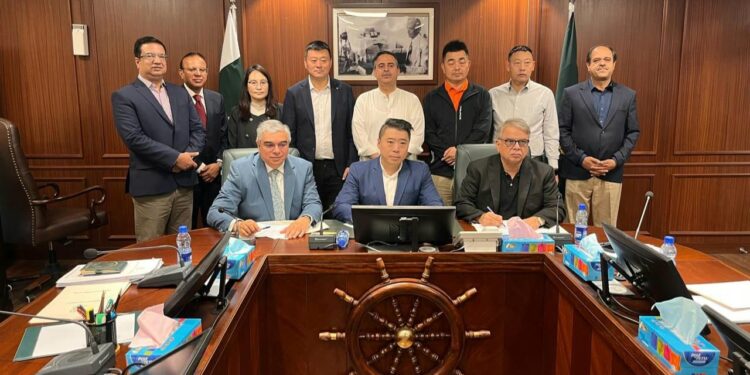
Pakistan and China have taken a significant leap forward in strengthening regional trade and supply chain connectivity with the formation of a China–Pakistan Joint Business Consortium. Leading logistics and business enterprises from both countries have agreed to collaborate on developing a modern logistics hub under the broader vision of the China–Pakistan Economic Corridor. The initiative reflects the growing momentum behind CPEC 2.0 and aims to upgrade transport networks, streamline trade operations and integrate cross border supply chains.
A partnership shaped through strategic dialogue
The consortium emerged from a high level meeting between Pakistani logistics companies and a Chinese delegation representing the All China Federation of Industry and Commerce and Precise Development (HK) Limited. The deliberations marked a milestone in Pakistan China business cooperation, paving the way for deeper engagement in logistics, infrastructure and trade facilitation. By bringing together public and private sector expertise, the consortium is designed to accelerate Pakistan’s transformation into a competitive regional logistics powerhouse.
Key enterprises unite under a new MoU
The memorandum of understanding brings together Pakistan Intermodal Limited and Habib Rafiq (Pvt) Limited with ACFIC and Precise Development (HK) Limited. The goal is to create a robust framework that supports the participation of Chinese logistics enterprises in Pakistan’s expanding logistics ecosystem. This partnership aligns with the Ministry of Maritime Affairs’ strategic priorities under Federal Minister Muhammad Junaid Anwar Chaudhry, particularly the effort to enhance maritime trade efficiency and infrastructure modernization.
The MoU was signed by three senior industry leaders: Zahid Nadeem of HRL, David Chu of Precise Development (HK) Limited and Aasim A. Siddiqui of PIL. Their collaboration will help guide the development of logistics networks and create long term business linkages that align with CPEC’s evolving vision.
Establishing a joint working group for long term coordination
Central to the consortium is the creation of a dedicated B2B Working Group responsible for coordinating logistics projects, monitoring progress and ensuring close engagement between Pakistani and Chinese stakeholders. The working group will serve as the primary platform for planning investments, implementing supply chain solutions and fostering a stable environment for cross border business partnerships. This mechanism is expected to give structure and continuity to the consortium’s activities over the coming years.
A strong Chinese presence
The Chinese delegation included Yi Jiang of ACFIC, David Chu and He He Amanda of Precise Development (HK) Limited. Representatives from major Chinese logistics firms, including Yunchuan Cross Border Company and Shenzhen A&E Container Transportation Co. Ltd., also participated. Their involvement underscores China’s strong interest in supporting Pakistan’s logistics modernization and enhancing the region’s overall trade architecture.
The meeting was coordinated by Khalid Taimur Akram, Director for the Eurasian Region at Precise Development (HK) Limited, who facilitated dialogue between the parties and helped outline practical steps for collaboration.
Transforming Pakistan into a regional trade hub
Participants emphasized that the new consortium will streamline logistics operations, reduce transit costs and improve supply chain efficiency. By integrating Chinese expertise with Pakistan’s strategic geographic location, the partnership aims to anchor Pakistan as a central hub for regional trade linking South Asia, Central Asia, the Middle East and Western China. The initiative supports broader CPEC and Belt and Road objectives, deepening economic cooperation and promoting regional connectivity.
A new chapter in Pakistan–China economic cooperation
Officials noted that the agreement reflects the ongoing strengthening of economic ties under CPEC. As Pakistan works to enhance its logistics infrastructure and expand its role in regional trade corridors, the consortium represents an important step toward realizing these goals. The joint effort will boost economic integration, attract new investment and position Pakistan as a key player in regional transport networks.

