
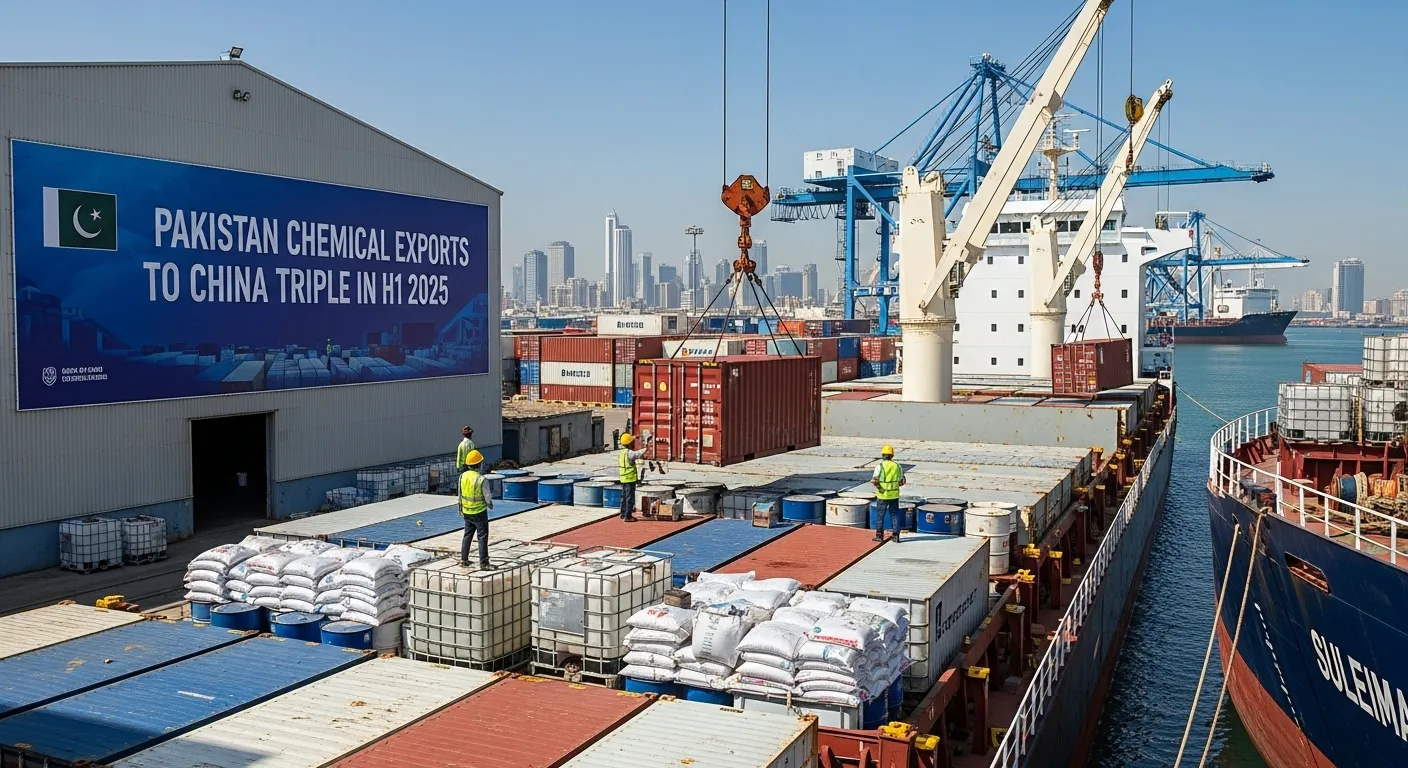
In a significant development underscoring the deepening economic ties between Pakistan and China, Pakistan’s chemical exports to China have experienced a remarkable threefold increase in the first half of 2025. This surge highlights the expanding diversification of Pakistan’s export portfolio and the growing demand for Pakistani chemical products in the Chinese market. The growth reflects not only the increased production capacity and competitiveness of Pakistan’s chemical sector but also the strategic importance of bilateral trade initiatives, including infrastructure improvements under the China-Pakistan Economic Corridor (CPEC), enhanced regulatory collaboration, and technological partnerships.
The chemical industry has long been a cornerstone of Pakistan’s manufacturing sector, encompassing a wide range of products, including fertilizers, plastics, dyes, industrial chemicals, and specialty chemicals. Over the past decade, the sector has undergone significant modernization, with investments in research and development, quality assurance, and sustainable production practices. The recent uptick in exports to China reflects the sector’s increasing competitiveness and the successful implementation of strategic initiatives aimed at enhancing production capabilities and meeting international quality standards. Pakistani chemical firms have also focused on compliance with global environmental and safety regulations, ensuring that their products meet stringent Chinese import requirements and international benchmarks.
Several factors have contributed to this impressive growth in chemical exports. Firstly, the establishment of Special Economic Zones (SEZs) under the China-Pakistan Economic Corridor (CPEC) has provided a conducive environment for industrial expansion. These zones offer modern infrastructure, tax incentives, and streamlined regulatory processes, attracting both domestic and foreign investment into the chemical sector. The Rashakai SEZ in Khyber Pakhtunkhwa and the Dhabeji SEZ in Sindh have become hubs for chemical manufacturing, facilitating increased production and enabling Pakistani firms to scale up operations to meet growing demand. By clustering chemical industries within these zones, Pakistan has improved supply chain efficiency, reduced production costs, and fostered industrial synergies that encourage collaboration and innovation.
Secondly, advancements in technology and innovation have played a pivotal role in the sector’s success. Pakistani chemical manufacturers have adopted modern production techniques, improved quality control measures, and invested heavily in research and development to enhance product offerings. The integration of automated production lines, advanced laboratory testing, and environmental management systems has increased both efficiency and compliance with international standards. Collaboration with Chinese firms has further facilitated technology transfer and knowledge sharing, allowing Pakistani companies to access cutting-edge manufacturing processes, raw material sourcing, and chemical formulation expertise. Such partnerships have helped Pakistani exporters meet stringent quality requirements in China, maintain consistent product standards, and compete effectively in a market with demanding consumers and strict regulatory oversight.
Thirdly, the strengthening of logistical infrastructure has significantly reduced transportation costs and delivery times. Upgrades to ports, roads, and rail networks, particularly those associated with CPEC, have streamlined the export process, ensuring the timely and efficient delivery of chemical products to China. Modern cargo handling systems at Gwadar Port, improved highways connecting production centers to export hubs, and the enhancement of rail freight corridors have collectively enhanced the reliability of supply chains. The improved connectivity has not only bolstered trade volumes but has also enhanced Pakistan’s position as a reliable supplier in the global chemical market, reinforcing confidence among Chinese buyers and international partners alike.
The surge in chemical exports to China has had a positive impact on Pakistan’s economy. It has contributed to a favorable trade balance, strengthened foreign exchange reserves, and generated employment opportunities across the sector. The growth in chemical exports has also stimulated related industries such as packaging, logistics, quality testing laboratories, and research and development. Local suppliers, transportation firms, and service providers have benefited from increased demand, creating a multiplier effect that supports broader economic growth. Moreover, the diversification of export markets has reduced Pakistan’s dependence on traditional trading partners, mitigating risks associated with global economic fluctuations and trade policy uncertainties in other regions.
Looking ahead, both governments are committed to further strengthening bilateral trade relations. Plans are underway to expand cooperation in areas such as petrochemicals, agrochemicals, industrial solvents, and specialty chemical production, with a focus on sustainable and environmentally friendly practices. Joint initiatives to enhance capacity building, promote joint ventures, and facilitate market access are being explored to ensure the continued growth and competitiveness of Pakistan’s chemical industry in the Chinese market. This includes training programs for Pakistani professionals, technology transfer agreements, and collaborative research efforts aimed at innovation in green chemistry, process optimization, and the development of high-value chemical products for domestic and export markets.
Analysts note that the growth in chemical exports represents a broader trend in the evolving Pakistan-China economic relationship. The success of the chemical sector demonstrates how strategic policies, infrastructure development, and technological collaboration can create tangible trade opportunities. It also underscores the importance of CPEC as a framework not only for energy and transport but also for fostering industrial modernization, trade facilitation, and skill development. The integration of chemical manufacturing hubs with transport infrastructure and policy support exemplifies a model that can be replicated in other high-value sectors, ensuring long-term sustainability and competitiveness.
From a regional perspective, Pakistan’s ability to expand chemical exports to China enhances its standing as a key economic partner and supplier in Asia. By capitalizing on China’s growing demand for industrial inputs and specialty products, Pakistan strengthens bilateral trade relations while diversifying its export base. The development also aligns with Pakistan’s long-term economic goals of industrialization, export-led growth, and technological advancement. The chemical sector’s expansion creates new opportunities for regional value chains, including collaboration with other CPEC partner industries, logistics companies, and research institutions.
conclusion
The tripling of Pakistan’s chemical exports to China in the first half of 2025 is a testament to the successful implementation of strategic policies, technological advancements, and infrastructural improvements. It reflects the evolving nature of Pakistan-China economic relations and sets a positive precedent for future collaborations in other sectors. The integration of SEZs, technological modernization, and logistics upgrades has created a robust framework that supports sustainable industrial growth, trade expansion, and regional economic integration. As both nations continue to work together under the CPEC framework, the chemical industry stands poised to play a pivotal role in Pakistan’s broader economic development, generating employment, strengthening bilateral ties, and contributing to a more diversified and resilient economy. The continued focus on quality, innovation, and collaboration ensures that Pakistan’s chemical exports will remain competitive in the Chinese market, creating a model of industrial and trade success that can be leveraged across multiple sectors in the years to come.

