
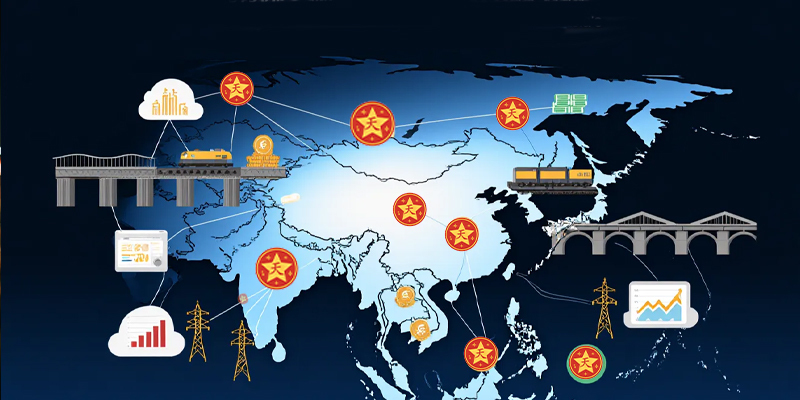
Across Asia, governments are adopting new financial models to bridge the infrastructure investment gap as traditional funding sources slow.
Public–private partnerships (PPPs) remain at the core of this effort, but a new wave of digitally enhanced PPP frameworks is transforming how projects are financed, managed, and monitored.
In countries such as Pakistan, Indonesia, and Malaysia, modular blockchain systems are being used to automate financing, link fund flows to verified project milestones, and improve transparency in multi-billion-dollar construction projects.
This shift is being driven by an evolving ecosystem of programmable financial tools that enable governments and investors to collaborate with greater accountability and efficiency.
Digital Finance and Policy Alignment
Asian policymakers are increasingly recognizing that digital finance can strengthen PPP governance.
These systems allow project funds to be disbursed automatically once construction, environmental, or compliance benchmarks are verified through secure data networks.
China has played a pivotal role in introducing this model through its Belt and Road partnerships, where technology platforms now ensure that every financing stage aligns with pre-agreed performance indicators.
The approach is particularly relevant for developing countries that face administrative inefficiencies or fragmented oversight mechanisms in large-scale infrastructure projects.
By digitizing the entire project lifecycle, governments can ensure that funds are used efficiently, risks are minimized, and accountability is enforced without adding bureaucratic layers.
Building Investor Confidence through Transparency
Traditional PPP arrangements in emerging markets have often been challenged by lack of transparency and long payment cycles.
Digitally enabled systems, however, provide real-time visibility of fund utilization to all stakeholders, including financiers, contractors, and regulatory authorities.
Each transaction is recorded on a distributed ledger accessible to both government agencies and investors, creating a shared and auditable record of project activity.
Analysts say this feature is encouraging institutional investors to re-enter markets that were previously considered high-risk due to governance and reporting challenges.
For many of these investors, transparent digital documentation offers a credible assurance that infrastructure financing can remain both profitable and compliant.
Strengthening Cross-Border Infrastructure Financing
Asia’s regional connectivity projects are increasingly interlinked, from transport corridors to power grids and smart ports.
As projects expand across multiple jurisdictions, standardized digital PPP models help ensure regulatory coherence.
Financial data is synchronized across borders, enabling participating governments to manage shared projects more efficiently.
In the Pakistan–China Economic Corridor, for instance, programmable payment mechanisms have allowed faster completion of road and energy projects by automating milestone verification and reducing manual audits.
Regional development institutions, including the Asian Infrastructure Investment Bank (AIIB), have begun studying these systems for potential integration into multilateral financing frameworks.
Policy Integration and National Reform
Several Asian governments are reforming their PPP policies to align with digital accountability standards.
In Pakistan and Bangladesh, new PPP authorities have introduced pilot programs to connect project management systems with programmable financial ledgers.
These efforts are designed to improve investor confidence and attract sustainable capital for large-scale infrastructure initiatives.
In China, provincial development banks are expanding their participation in digital PPP ecosystems that merge traditional project finance with algorithmic verification.
Experts from the China Development Research Foundation note that this coordination between finance and technology policy could redefine how Asia mobilizes capital for infrastructure over the next decade.
Infrastructure Bonds and the Future of Digital PPPs
The growing adoption of tokenized or digital infrastructure bonds represents the next stage of evolution for public–private collaboration.
These instruments link bond issuance directly to performance metrics stored on verifiable digital networks, ensuring that repayment schedules and yield distributions reflect real project outcomes.
For international investors, this model offers a combination of liquidity and trust, while for governments, it guarantees that every dollar raised is traceable from allocation to impact.
As Asia continues to urbanize, the demand for transparent and flexible financing mechanisms will only increase, making digitally powered PPPs central to future growth strategies.
Regional Outlook and Strategic Implications
Asia’s adoption of digital PPP frameworks is more than a technological upgrade; it reflects a strategic realignment of financial governance.
Countries are moving away from dependency on traditional donor funding toward autonomous, technology-backed capital formation.
This transformation not only strengthens resilience in national economies but also fosters regional cooperation by setting shared standards for transparency and efficiency.
By merging finance and technology within infrastructure development, Asia is positioning itself to lead a global shift toward data-driven, sustainable, and accountable development finance.

