
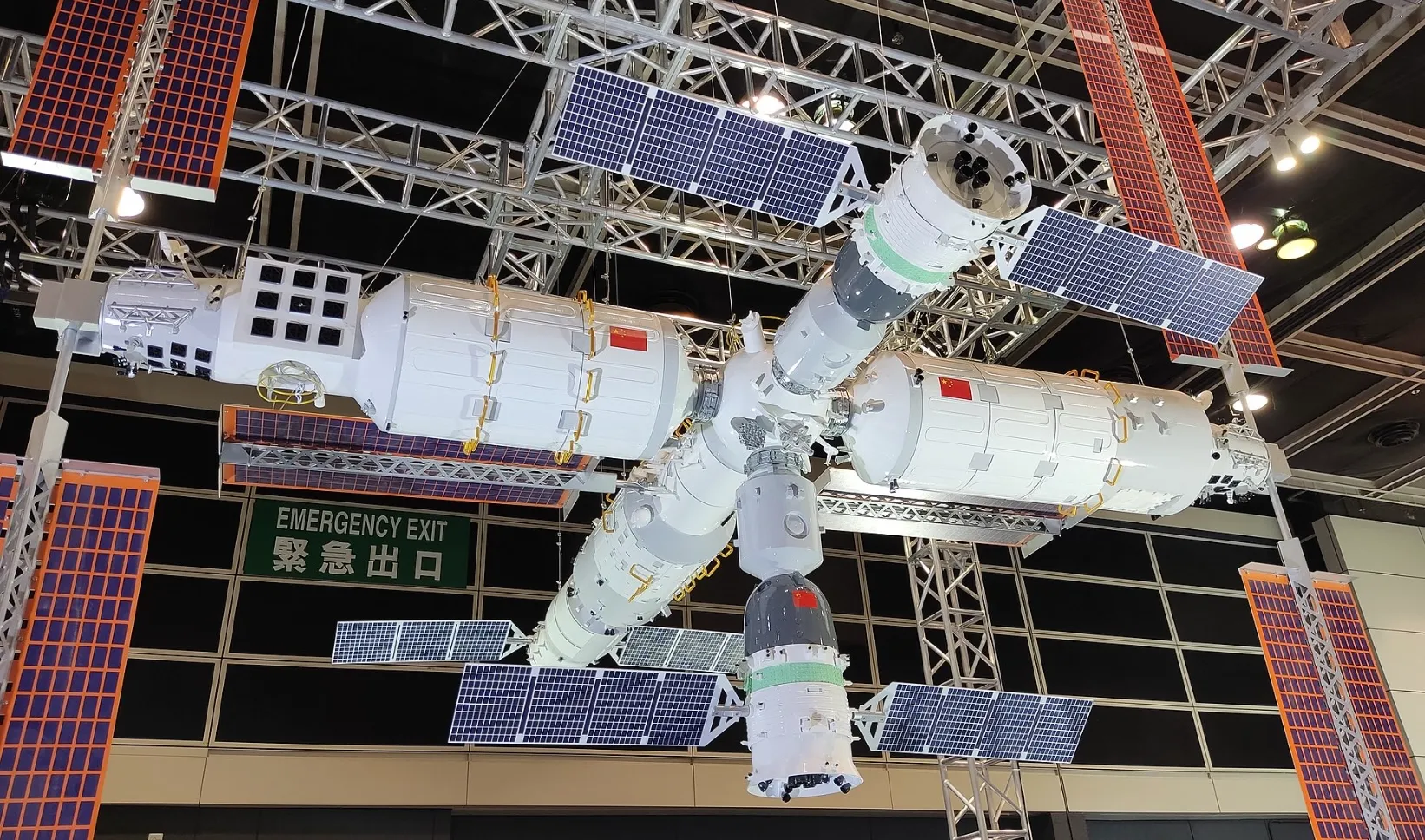
China’s space station recorded steady and wide ranging progress in scientific research and technological experimentation throughout 2025, reflecting the country’s growing capabilities in space based science. According to China’s Technology and Engineering Center for Space Utilization under the Chinese Academy of Sciences, a total of 31 new projects were carried out over the year, spanning multiple disciplines and reinforcing the station’s role as a long term research platform.
The projects covered space science, applied research, and technology testing, with a strong emphasis on experiments that can only be conducted in the unique environment of low Earth orbit. Officials said the pace and diversity of the work demonstrate that China’s space station has moved beyond basic construction and operations into a phase focused on sustained scientific output.
One of the most significant developments in 2025 was the continued expansion of onboard scientific facilities. The space station now supports experiments in life sciences, microgravity physics, materials science, and emerging space technologies. These facilities provide researchers with stable conditions and advanced tools needed to conduct long duration studies that are difficult or impossible to replicate on Earth.
Life sciences research remains a key focus area. Experiments conducted in microgravity are helping scientists better understand how the space environment affects biological systems, including cell growth, metabolism, and adaptation. Such studies have implications not only for long term human spaceflight, but also for medical and biological research on Earth.
Microgravity physics experiments are another core component of the program. Researchers are using the space station to study fluid behavior, combustion, and fundamental physical processes without the interference of gravity. These experiments contribute to basic scientific knowledge and support the development of new technologies in energy, materials, and industrial processes.
The station is also serving as a testbed for new space technologies and applications. Technology validation experiments in 2025 included tests of advanced sensors, space manufacturing techniques, and systems designed to improve spacecraft reliability and efficiency. Officials say these trials are essential for supporting future deep space missions and expanding China’s overall space capabilities.
According to the Technology and Engineering Center for Space Utilization, the integration of scientific facilities has provided critical support for core research missions. The coordinated design of experimental modules allows multiple projects to operate simultaneously, improving efficiency and maximizing the scientific return from each crewed mission.
The steady progress reported for 2025 reflects a broader strategy to position the space station as an open and long term research platform. Chinese authorities have previously stated that the station will support international cooperation and host experiments proposed by scientists from other countries, reinforcing its role in global space research.
Analysts note that consistent scientific output is a key indicator of a mature space station program. Rather than focusing solely on symbolic achievements, China is increasingly emphasizing practical research results and technological development.
As the space station continues to operate, further expansion of experiments and facilities is expected. The achievements of 2025 suggest that China is building a stable foundation for sustained space science, with long term benefits for research, technology, and future exploration beyond low Earth orbit.

