
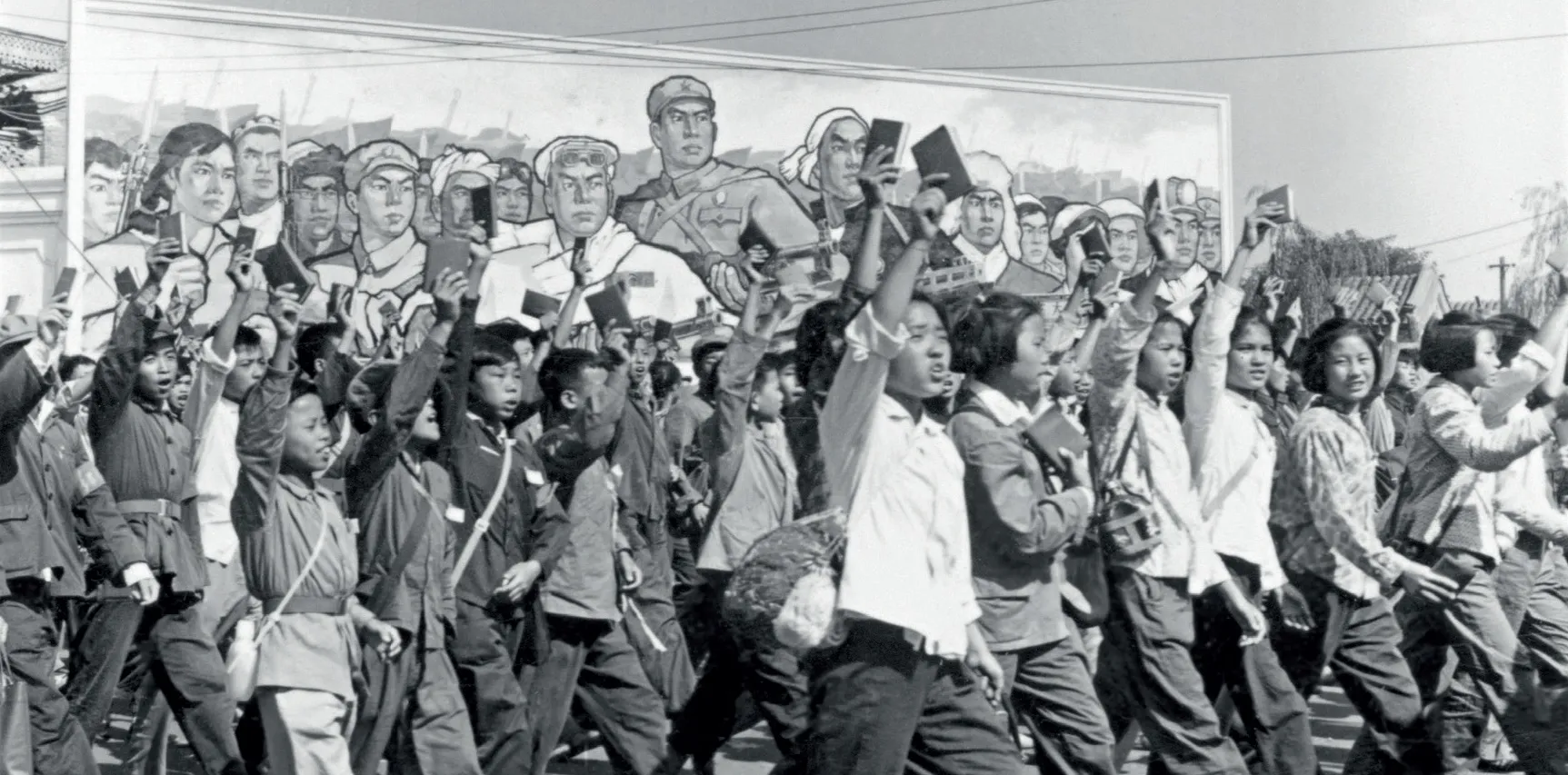
A decade of upheaval that transformed Chinese society and politics.
The Call to Revolution
In 1966, Mao Zedong launched the Great Proletarian Cultural Revolution, urging young people to rise against what he called “capitalist roaders” within the Communist Party. Mao feared that the revolution was losing its ideological purity and sought to reassert his dominance after the failures of the Great Leap Forward.
Students, organized as Red Guards, answered the call. Waving copies of the Little Red Book, they challenged teachers, officials, and even family members, turning classrooms and workplaces into battlegrounds of loyalty.
Chaos and Violence
What began as political mobilization quickly spiraled into chaos. Red Guards attacked symbols of tradition, destroying temples, artworks, and historical relics. Intellectuals were humiliated in public “struggle sessions,” while countless officials were purged, imprisoned, or sent to rural labor camps.
The violence spread nationwide. Cities saw factional clashes between rival Red Guard groups, while rural communities endured waves of suspicion and persecution. Millions of lives were disrupted, and trust within families and communities was shattered.
Mao’s Grip and the Cult of Personality
The Cultural Revolution elevated Mao’s image to near-deity status. Portraits of Mao adorned homes, factories, and schools. His words became unquestionable truths, recited in mass rallies and studied daily.
By placing himself above Party institutions, Mao dismantled collective leadership, ensuring that loyalty to him personally outweighed bureaucratic authority. This personalization of power deepened the movement’s volatility, as policies shifted with Mao’s favor.
Impact on Education and Culture
China’s schools and universities were paralyzed for years. Classes were suspended as students joined political campaigns. Generations lost access to formal education, with long-term effects on careers and intellectual development.
Cultural production was strictly controlled. Revolutionary operas and propaganda dominated the arts, replacing traditional works. Writers and artists either conformed to the new orthodoxy or faced suppression.
Life in the Countryside
Millions of young urbanites were sent to rural areas under the “Up to the Mountains, Down to the Countryside” movement. The aim was to harden them through labor and bring them closer to peasant life. For many, it was an experience of hardship, isolation, and wasted potential, though some gained appreciation for rural struggles.
This relocation shaped an entire generation’s outlook, leaving scars but also memories of resilience.
The End of the Revolution
After Mao’s death in 1976, the Cultural Revolution quickly lost momentum. The arrest of the Gang of Four, a group of Mao’s closest allies, marked its official end. The new leadership condemned the decade as a disaster that caused “ten years of turmoil.”
China then turned toward economic reform under Deng Xiaoping, prioritizing modernization over ideology. The Cultural Revolution was reframed as a warning against unchecked personal power and ideological extremism.
Legacy and Memory
The Cultural Revolution remains one of the most controversial periods in modern Chinese history. Official narratives emphasize its destructive chaos, while personal memoirs capture both trauma and resilience. Public discussion within China is limited, but the memories of lost years, broken families, and destroyed traditions endure.
Internationally, it is studied as an example of how mass mobilization, ideology, and authoritarian control can destabilize entire societies.
Conclusion: Ideology at the Expense of Stability
The Cultural Revolution was a movement meant to restore purity but instead unleashed chaos. It demonstrated the dangers of ideology unchecked by institutions and the consequences of placing personal power above collective governance.
The Cultural Revolution is a reminder of how deeply politics can invade daily life. It shows how the pursuit of purity, when turned into mass mobilization, can reshape a nation but at immense human cost.

