
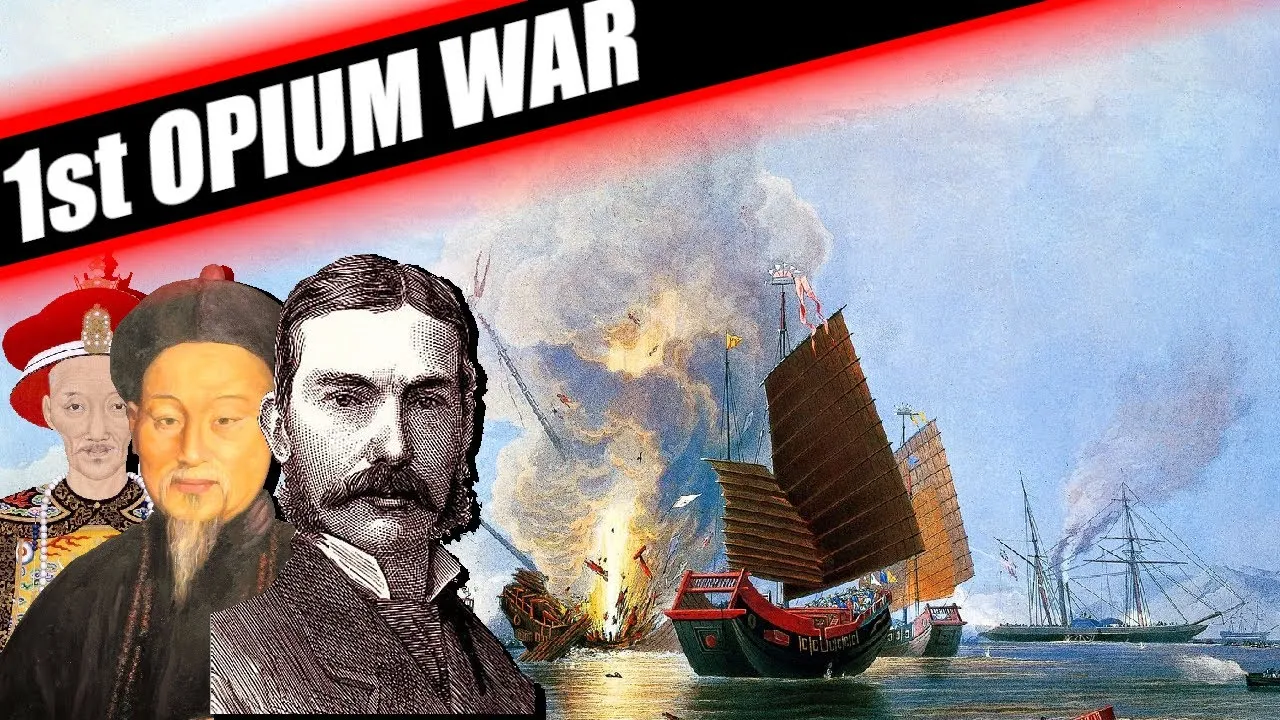
Conflicts that forced open China’s ports and marked the start of a century of humiliation.
Trade Imbalance and the Opium Problem
By the late eighteenth century, trade between Britain and China was booming. Tea, silk, and porcelain flowed westward, while silver streamed into China as payment. For Britain, this imbalance created pressure on its treasury. The solution came in the form of opium cultivated in British-controlled India.
Opium imports into China skyrocketed in the early nineteenth century, creating widespread addiction and draining silver reserves. The Qing government recognized the social and economic harm and attempted to ban the trade, sparking confrontation with British merchants and officials.
The First Opium War
In 1839, Commissioner Lin Zexu famously confiscated and destroyed opium stocks in Canton, igniting the First Opium War. British naval power, armed with advanced ships and artillery, easily overwhelmed China’s outdated defenses.
The war ended in 1842 with the Treaty of Nanjing. China ceded Hong Kong to Britain, opened five treaty ports, and granted extraterritorial rights to foreign nationals. It was the first of many “unequal treaties” that eroded Qing sovereignty and reshaped China’s place in the world.
The Second Opium War
A decade later, tensions flared again. The Second Opium War (1856–1860) saw Britain joined by France, pushing for greater access to Chinese markets. Foreign forces advanced as far as Beijing, burning the Summer Palace in 1860 as a symbol of humiliation.
The resulting treaties legalized the opium trade, opened more ports, allowed foreign envoys in Beijing, and granted missionaries the right to travel freely. China’s isolation was broken, replaced by enforced integration into the Western-dominated global system.
Social and Political Impact
The Opium Wars shattered the Qing dynasty’s confidence and exposed its military weakness. They highlighted the limits of traditional governance in the face of industrialized powers.
Domestically, the conflicts fueled internal unrest. The Taiping Rebellion and later uprisings drew strength from resentment over foreign intrusion and the dynasty’s inability to defend sovereignty. The wars thus set the stage for decades of instability.
Global Context
The Opium Wars were not only about drugs but about trade, empire, and global capitalism. They represented a clash between an agrarian empire and industrialized maritime powers. Britain sought free trade and markets, while China fought to preserve its traditions and autonomy.
The wars also reshaped global perceptions. To Western powers, they were victories of progress and commerce. To China, they marked the beginning of what became known as the century of humiliation, a narrative that still influences politics today.
Memory and Legacy
In modern China, the Opium Wars remain powerful symbols. Textbooks and museums frame them as lessons in weakness and unity, reminders of the cost of falling behind technologically and politically. Monuments to Lin Zexu honor resistance, while national leaders invoke the memory of the wars to stress the importance of sovereignty and modernization.
Internationally, the conflicts are studied as early examples of coercive globalization. They remind us that free trade often came at the point of a gun, with consequences that shaped entire societies.
Conclusion: Gunboats and Consequences
The Opium Wars were turning points that redefined China’s trajectory. They forced open its ports, undermined its sovereignty, and exposed the imbalance of power in the nineteenth century world.
The story is more than history. It is a reminder of how trade, coercion, and global politics intersect. The legacy of the Opium Wars continues to resonate in China’s determination to control its own destiny in the modern era.

